Why urea efficiency matters
Urea is the backbone of crop nutrition in India. It is affordable, widely available and contains 46% nitrogen, the highest of any common solid fertilizer. But a large part of the nitrogen in every bag never reaches the crop. Agronomy research has long shown that crops typically recover only around a third to a half of applied nitrogen in the season of application, with the rest lost to the air, water or soil.
For the farmer, that means paying for nitrogen the crop never uses. For the environment, it means ammonia in the air, nitrate in groundwater and nitrous oxide, a greenhouse gas. Improving nitrogen use efficiency (NUE) is good for both.
How urea nitrogen is lost
After urea is applied, an enzyme in the soil called urease converts it to ammonium. Soil bacteria then convert ammonium to nitrate. Losses can happen at each step.
1. Ammonia volatilisation
When urea is converted to ammonium on or near the soil surface, part of it can escape into the air as ammonia gas. Losses are highest when:
- urea is broadcast on the surface and not incorporated
- the soil is moist but not followed by enough irrigation or rain to move urea into the soil
- temperatures are high
- the soil is alkaline or calcareous
2. Leaching
Nitrate is highly mobile. Heavy rain or excessive irrigation can wash it below the root zone, especially in light, sandy soils. This nitrogen is lost to the crop and can reach groundwater.
3. Denitrification
In waterlogged or poorly drained soils, such as flooded paddy fields or low-lying patches, soil bacteria convert nitrate into nitrogen gases that escape into the air.
4. Runoff
When heavy rain or flood irrigation follows soon after a top-dressing, dissolved urea and nitrogen can be carried off the field in surface water.
| Loss pathway | Form lost | Highest risk when |
|---|---|---|
| Volatilisation | Ammonia gas | Surface-broadcast urea, warm weather, alkaline soil |
| Leaching | Nitrate | Sandy soils, heavy rain or over-irrigation |
| Denitrification | Nitrogen gases | Waterlogged soils, flooded paddy |
| Runoff | Dissolved urea/nitrogen | Heavy rain or flood irrigation soon after application |
Practical ways to reduce urea loss
Split application and timing
Applying all the nitrogen at once, early in the season, puts a lot of urea in the soil before the crop can use it. Splitting nitrogen into two or three doses matched to crop demand is a well-established practice. In cereals, this typically means a basal dose and one or two top-dressings at active growth stages such as tillering or before panicle initiation. Follow your state agricultural university's recommendations for your crop and region.
Placement and incorporation
Where possible, incorporate urea into the soil or apply it just before a light irrigation so it moves into the root zone rather than sitting on the surface. Avoid top-dressing just before heavy rain is forecast.
Water management
Avoid over-irrigation in light soils to limit leaching. In paddy, avoid applying urea into deep standing water; follow local guidance on draining and re-flooding around top-dressing.
Use soil testing
Apply nitrogen according to soil test results and crop requirement. Excess nitrogen is the most likely to be lost.
Neem-coated urea
Since 2015, the Government of India has required urea for agricultural use to be neem-coated. The neem coating slows the conversion of nitrogen in the soil, which helps reduce some losses and discourages diversion of agricultural urea for non-farm use. It is a useful step, but it does not remove the need for good timing, placement and split application.
Where Verdesian nitrogen technologies fit
Beyond good practice, nitrogen technologies can help keep more of the applied nitrogen available to the crop.
N-Charge™ G for urea and nitrogen fertilizers
N-Charge™ G is a nitrogen fertilizer enhancer used with urea and other nitrogen fertilizers. It uses Verdesian's patented T5 polymer technology. Its mode of action is described in three steps:
- Nutrient availability: the polymer acts as an exchange resin, supporting in-season improvement of nitrogen use efficiency.
- Nutrient accessibility: more ammonium is available to the plant during peak nitrogen demand.
- Nutrient uptake: total nitrogen uptake increases during the season.
N-Charge™ G helps protect nitrogen from loss to the environment by improving its availability to the plant, and is described as protecting soil health and water quality. Practical points for dealers: it has 50–90% less build-up on equipment, can be stored indefinitely with no loss in quality, and works well in all weather conditions.
LYRA™ for fertigated nitrogen
On drip-irrigated crops, nitrogen is supplied through water-soluble fertilizers, and nitrate leaching is still a risk. LYRA™ is a supplemental fertigation enhancer combining Verdesian's Copolymer, Take-Off and Plus technologies. It improves nutrient availability by mitigating nitrate leaching and improves nutrient uptake.
- Dose: 2.5–5 ml per kg of water-soluble fertilizer
- Time of application: At fertigation, along with water-soluble fertilizer
- Instructions: Apply in proportion to and together with applied nitrogen
Take Off technology for nitrogen assimilation
Keeping nitrogen in the soil is half the job; the plant also has to take it up and use it. Verdesian's Take Off technology works inside the plant.
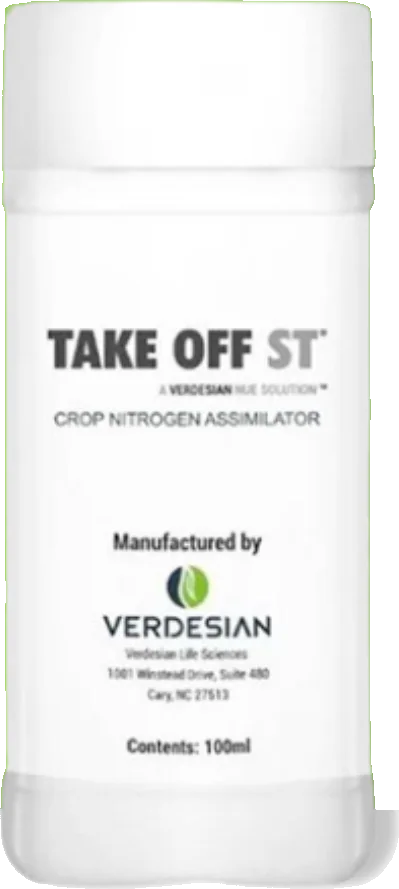
Take Off® ST is a crop nitrogen assimilator for seed treatment. It mimics a natural plant metabolite common in all crops and works inside the plant to accelerate carbon fixation and increase nitrogen uptake and use efficiency. The dose is 1 ml per packet of seed, in 10 ml, 25 ml, 100 ml and 1 L packs.
primacyALPHA® is a biostimulant that combines a cytokinin precursor, a chlorophyll precursor and Take Off technology. It works inside the plant to stimulate efficient assimilation and utilisation of nutrients and increases nutrient uptake, utilisation and delivery. The dose is 400 ml per acre, or 2.5–3 ml per litre of water.
| Situation | Technology | How it is used |
|---|---|---|
| Urea and other N fertilizers in field crops | N-Charge™ G | With urea and other nitrogen fertilizers |
| Nitrogen through drip | LYRA™ | 2.5–5 ml per kg of water-soluble fertilizer, at fertigation |
| Nitrogen assimilation from the start | Take Off® ST | Seed treatment, 1 ml per packet of seed |
| Nutrient assimilation in the standing crop | primacyALPHA® | 400 ml per acre, or 2.5–3 ml per litre of water |
Key takeaways
Urea nitrogen is lost through volatilisation, leaching, denitrification and runoff. Split application, good timing, incorporation, sensible irrigation and soil testing are the foundation of better nitrogen use efficiency, and neem-coated urea helps but is not enough on its own. N-Charge™ G and LYRA™ help keep applied nitrogen available to the crop, while Take Off® ST and primacyALPHA® use Take Off technology to support nitrogen assimilation inside the plant.
To build a nitrogen plan for your crop and soil, talk to a Verdesian agronomist or request our trial reports.
Frequently asked questions
How is urea nitrogen lost from the field?
Urea nitrogen is mainly lost as ammonia gas (volatilisation), as nitrate washed below the root zone (leaching), as nitrogen gases from waterlogged soils (denitrification) and through surface runoff after heavy rain or irrigation.
Does neem-coated urea stop nitrogen loss completely?
No. Neem coating slows the conversion of nitrogen in the soil and helps reduce some losses, but good timing, placement and split application are still needed.
How does N-Charge G help reduce nitrogen loss?
N-Charge G uses Verdesian's patented T5 polymer, which acts as an exchange resin so more ammonium is available to the plant during peak nitrogen demand. This helps protect nitrogen from loss by improving its availability to the plant.
What is the dose of LYRA in fertigation?
LYRA is used at 2.5–5 ml per kg of water-soluble fertilizer, applied at fertigation in proportion to and together with applied nitrogen.