Why "rich" soil can still starve a crop
Many Indian fields have received DAP, potash and other fertilizers for years. A soil test may even show good total reserves of phosphorus or potassium. Yet crops in the same field show poor rooting, purple leaves, weak grain filling or zinc deficiency.
The reason is often nutrient lock-up: the nutrient is in the soil, but in a form the roots cannot easily take up. Freeing these nutrients – and stopping freshly applied fertilizer from getting locked up – is one of the most practical ways to improve yield and fertilizer returns.
How nutrients get locked up in Indian soils
Phosphorus fixation
Phosphorus is the classic locked-up nutrient. Soon after DAP or SSP is applied, the phosphate starts reacting with soil minerals:
- In alkaline and calcareous soils – common in large parts of north-west, western and central India – phosphate reacts with calcium to form calcium phosphates of low solubility.
- In acidic soils – found in the North-East, parts of the Western Ghats and other high-rainfall areas – phosphate binds with iron and aluminium.
Phosphorus is generally most available in a near-neutral pH range. The further the soil is from this range, the stronger the fixation tends to be. This is why only a small share of applied phosphorus is typically used by the crop in the season of application, and why phosphorus tends to build up in soils over time.
Potassium fixation
Potassium can be trapped between the layers of certain clay minerals, such as illite and vermiculite. Once held there, it is released only slowly. Soils with high amounts of these clays can fix part of the applied potash, so the crop gets less than expected – often showing up at grain filling and fruit colouring, when potassium demand is high.
Zinc deficiency
Zinc deficiency is one of the most widespread micronutrient problems in Indian agriculture. It is more common in:
- Alkaline and calcareous soils
- Soils low in organic matter
- Intensively cropped rice-wheat systems
- Flooded paddy fields, where zinc availability falls
In paddy, zinc deficiency is widely known as khaira, with bronze or rusty-brown patches on older leaves and stunted plants. High phosphorus levels can also make zinc deficiency worse.
Start with a soil test
Before buying any product, find out what your soil actually needs. A soil test gives you:
- Soil pH – tells you whether phosphorus fixation is likely to be driven by calcium (alkaline) or iron and aluminium (acidic).
- Available N, P and K – the levels that matter for the current crop.
- Micronutrients such as zinc, iron, manganese and boron.
- Organic carbon – a simple indicator of soil health.
Government soil testing laboratories and the Soil Health Card scheme are good starting points. Testing once every two to three years, and before changing your crop or fertilizer plan, is a common practice.
How to free locked-up nutrients
Good basic practice helps: placing phosphatic fertilizer near the root zone rather than broadcasting, adding organic matter, and correcting pH where needed. Verdesian's soil-applied technologies add a further layer of protection for applied nutrients.
| Product | Nutrient focus | How it helps | Dose / method |
|---|---|---|---|
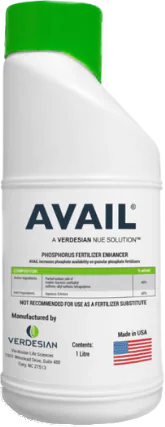
| AVAIL® | Phosphorus | Binds Ca, Mg and Al ions so phosphorus stays free for uptake | Used with DAP, SSP and other phosphatic fertilizers |
| Steric P | Phosphorus | Delays phosphorus fixation in alkaline or acidic soils | 800 g per acre, soil application |
| Steric K | Potassium | Delays potassium fixation in alkaline or acidic soils | 800 g per acre, soil application |
| CropSync Complete™ | Micro and secondary nutrients | Polymer-protected granules for season-long availability | Soil application (granules) |
AVAIL® – keeping DAP phosphorus available
AVAIL® is a resin-based technology with a charge of −1800 meq CEC. It attracts and binds the positive ions – calcium, magnesium and aluminium – that would otherwise react with phosphorus. This leaves phosphorus free and more soluble for roots. According to Verdesian, AVAIL® makes up to 45% more phosphorus accessible to crops, promotes season-long uptake and results in less phosphorus build-up in the soil.
Steric P – shielding the phosphate ion
Steric P is soil-applied and delays the chemical fixation reactions of phosphorus in alkaline or acidic soils. Its patented steric chemistry wraps around the phosphate ion and shields its negative charges, so it cannot react with soil chemistry. Phosphorus stays available for longer, giving better results with less fertilizer. Stated benefits include enhanced crop vigour, increased root mass and improved soil health.
Dose: 800 g per acre, soil application.
Steric K – keeping potassium in play
Steric K delivers soil-applied potassium and delays the chemical fixation reactions of potassium in alkaline or acidic soils, so potassium stays available for longer. Its stated benefits include better colour development in fruits and vegetables, increased grain filling in panicles and enhanced quality of the final produce.
Dose: 800 g per acre, soil application.
CropSync Complete™ – micronutrients on demand
CropSync Complete™ combines Verdesian's polymer technology with the Nutripaction™ process to make a micronutrient granule. When the granules meet soil moisture, they break down into fine particles for maximum soil contact and root-zone interception. The co-polymer protects the micro and secondary nutrients for season-long availability, supporting a stronger root and shoot system and better nutrient use efficiency.
For fields where zinc is the main concern, Verdesian also offers granular CytoZ-GR (zinc gluconate 12%) at 3 kg per acre as a soil application.
A simple plan for your field
- Test your soil and note pH, available P and K, and zinc status.
- Identify the likely lock-up – calcium-driven phosphorus fixation in alkaline soils, iron/aluminium fixation in acidic soils, potassium fixation in heavy clays, or zinc deficiency.
- Choose the right tool – AVAIL® or Steric P for phosphorus, Steric K for potassium, CropSync Complete™ for micro and secondary nutrients.
- Place fertilizer well and keep adding organic matter where possible.
- Compare results with a small untreated strip.
Talk to a Verdesian agronomist
Seeing deficiency symptoms despite regular fertilizer use? Contact a Verdesian agronomist to discuss your soil test, or request our trial reports.
Frequently asked questions
What is nutrient lock-up?
Nutrient lock-up is when a nutrient is present in the soil but held in forms that roots cannot easily absorb – for example, phosphorus bound to calcium in alkaline soils or to iron and aluminium in acidic soils.
Why do crops show phosphorus deficiency even after DAP?
Much of the phosphorus from DAP and other phosphatic fertilizers can react with soil minerals soon after application and become fixed, so less of it remains available to the crop.
How does Steric P work?
Steric P is soil-applied and delays the chemical fixation reactions of phosphorus in alkaline or acidic soils. Its patented chemistry shields the phosphate ion so it stays available for longer. The dose is 800 g per acre.
How often should I test my soil?
A common practice is to test soil once every two to three years, and before major changes in crop or fertilizer plan. Your local soil testing laboratory or Soil Health Card scheme can help.