What is nutrient use efficiency?
Nutrient use efficiency (NUE) is a simple idea: of all the fertilizer you put into the field, how much actually ends up inside the crop and contributes to yield?
If a farmer applies a bag of urea or DAP and the crop takes up only a part of it, the rest is either lost from the field or locked up in the soil in forms roots cannot use. That unused part is money spent without a return. For dealers and distributors, NUE is increasingly the conversation that matters, because growers want more yield from the same fertilizer spend.
NUE can be measured in different ways by scientists (recovery efficiency, agronomic efficiency and so on), but for a farmer the practical question is the same: how do I get more crop from every bag?
Why crops recover only part of applied N, P and K
Textbooks and agronomy research in India have long shown that crops recover only a portion of applied fertilizer in the season it is applied. The commonly cited ranges are cautious estimates and vary with soil, crop and management, but the pattern is consistent:
| Nutrient | Typical recovery by the crop (often cited) | Main reasons for low recovery |
|---|---|---|
| Nitrogen (N) | Often around 30–50% | Ammonia volatilisation, nitrate leaching, denitrification, runoff |
| Phosphorus (P) | Often under 20–25% | Fixation with calcium (alkaline soils) or iron and aluminium (acidic soils) |
| Potassium (K) | Often around 50–70% | Fixation in certain clay minerals, leaching in light soils |
Nitrogen
Urea is the most widely used fertilizer in India. Once applied, it converts to ammonium and then nitrate. Along the way, nitrogen can escape as ammonia gas (especially when urea is broadcast on the surface of moist, warm soil), wash below the root zone as nitrate after heavy rain or irrigation, or be lost as gas from waterlogged soils such as paddy fields.
Phosphorus
Phosphorus losses are less about escape and more about fixation. In the alkaline soils common across much of north and central India, phosphate reacts with calcium. In acidic soils, it reacts with iron and aluminium. In both cases, the phosphorus stays in the soil but in forms the crop struggles to use. This is why many fields show high soil P build-up over the years while crops still respond to fresh DAP or SSP.
Potassium
Potassium is generally recovered better than N or P, but it can be held in some clay minerals or lost by leaching in sandy soils.
The 4R approach: right source, rate, time and place
The 4R nutrient stewardship framework is a widely used way to think about improving NUE. It does not require any special product; it is good agronomy.
- Right source – choose the fertilizer form that suits the crop and soil (for example, water-soluble fertilizers for drip, phosphatic fertilizers for basal application).
- Right rate – apply according to soil testing and the crop's actual requirement, not habit. The Soil Health Card is a useful starting point.
- Right time – apply nutrients close to when the crop needs them. Splitting nitrogen into two or three doses is a common example.
- Right place – put nutrients where roots can reach them, such as band or drill placement of phosphorus near the seed row instead of broadcasting.
Getting the 4Rs right is the foundation. NUE technologies are designed to work on top of good practice, not as a replacement for it.
Where NUE products fit
Even with good timing and placement, soil chemistry and weather still cause losses. Fertilizer enhancers and soil-applied technologies are designed to address these specific loss pathways. Below is how Verdesian's NUE products are described.
AVAIL® – phosphorus fertilizer enhancer
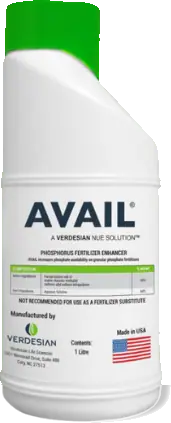
AVAIL® is used with phosphatic fertilizers such as DAP and SSP. It is a resin-based technology with a charge of −1800 meq CEC. It attracts and binds positive ions such as calcium, magnesium and aluminium in the soil, leaving phosphorus free for uptake by crop roots. AVAIL® is described as making up to 45% more phosphorus accessible to crops and promoting season-long phosphorus uptake. Listed benefits include better early-season crop performance, a more robust root and shoot system, and less phosphorus build-up in soil.
Steric P – soil-applied phosphorus protection
Steric P is soil-applied at 800 g per acre. It delays the chemical fixation reactions of phosphorus in alkaline or acidic soils. Its patented steric chemistry wraps around the phosphate ion and shields its negative charges so it cannot react with soil chemistry, keeping phosphorus available for longer.
N-Charge™ G – nitrogen fertilizer enhancer
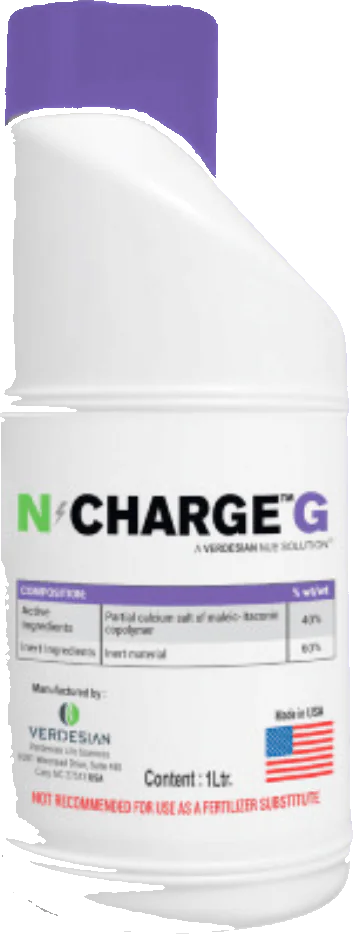
N-Charge™ G is used with urea and other nitrogen fertilizers. It uses Verdesian's patented T5 polymer technology, which acts as an exchange resin so that more ammonium is available to the plant during peak nitrogen demand. It is designed to support in-season nitrogen use efficiency and increase total nitrogen uptake through the season, and helps protect nitrogen from loss to the environment by improving its availability to the plant.
LYRA™ – fertigation enhancer
For growers using drip and water-soluble fertilizers, LYRA™ is formulated for fertigation in speciality and row crops. It combines Verdesian's Copolymer, Take-Off and Plus technologies. The dose is 2.5–5 ml per kg of water-soluble fertilizer, applied at fertigation in proportion to and together with applied nitrogen. LYRA™ is described as improving nutrient availability by mitigating nitrate leaching, and enhancing abiotic stress tolerance.
| Loss problem | Typical situation | Verdesian technology |
|---|---|---|
| Phosphorus fixation | Basal DAP/SSP in alkaline or acidic soils | AVAIL®, Steric P |
| Nitrogen loss from urea | Top-dressed urea in field crops | N-Charge™ G |
| Nitrate leaching under drip | Fertigation with water-soluble fertilizers | LYRA™ |
What NUE means for farmers and dealers
For a farmer, better NUE means more of each rupee spent on fertilizer turns into crop. It can also mean a healthier soil over time, because less unused phosphorus accumulates and less nitrogen is lost to water.
For a dealer or distributor, NUE products offer a way to add value to the fertilizer you already sell. Instead of competing only on price per bag, you can help customers get better results from that bag. A few practical points when advising growers:
- Start with a soil test and the 4Rs; NUE products work best on a sound base.
- Match the product to the problem: P fixation, N loss or leaching under drip.
- Follow label doses exactly and do not cut the recommended fertilizer dose without agronomic advice.
- Compare results with a simple side-by-side strip in the farmer's own field.
Key takeaways
Nutrient use efficiency is about getting more from what you already apply. Nitrogen is lost mainly to the air and water, phosphorus is locked up by soil chemistry, and potassium can be fixed or leached. The 4R approach is the foundation, and fertilizer enhancers such as AVAIL®, Steric P, N-Charge™ G and LYRA™ are designed to tackle specific loss pathways on top of good practice.
Want to know which NUE approach suits your soil and crop? Talk to a Verdesian agronomist or request our trial reports.
Frequently asked questions
What does nutrient use efficiency (NUE) mean?
NUE describes how much of the nutrient you apply as fertilizer is actually taken up by the crop and turned into yield. A higher NUE means less fertilizer is lost to the soil, air or water.
Why is phosphorus use efficiency usually so low?
Applied phosphorus reacts quickly with calcium in alkaline soils and with iron and aluminium in acidic soils, forming compounds that roots cannot easily take up. Only a small share of applied P is typically used by the crop in the season of application.
What are the 4Rs of nutrient management?
The 4Rs are the right source, right rate, right time and right place. Together they aim to match fertilizer supply to crop demand while reducing losses.
Do NUE products replace fertilizer?
No. NUE products such as fertilizer enhancers work along with your fertilizer to help keep nutrients available to the crop. They do not supply the full nutrient requirement on their own.