Why phosphorus needs special attention
Phosphorus (P) drives early root growth, energy transfer inside the plant, flowering and grain or seed formation. A crop that is short of phosphorus in the first few weeks often stays stunted, with a weak root system and delayed maturity.
Indian farmers apply large quantities of DAP and SSP every season, yet phosphorus deficiency is still common. The reason is not usually too little fertilizer – it is that much of the phosphorus applied gets locked up in the soil before the crop can use it. Good phosphorus management is about keeping more of what you apply available to the roots.
How soil pH controls phosphorus availability
Phosphorus is most available to plants in a near-neutral soil, typically around pH 6 to 7.5. Outside this range, it reacts with other elements in the soil:
- Alkaline and calcareous soils (high pH) – common in much of north-west and central India. Phosphate reacts with calcium to form calcium phosphates that are poorly soluble.
- Acidic soils (low pH) – common in high-rainfall areas such as the North-East, parts of Kerala, Odisha and the hills. Phosphate reacts with iron and aluminium to form compounds roots cannot easily use.
| Soil condition | Main reaction | Effect on phosphorus |
|---|---|---|
| Alkaline / calcareous | Binds with calcium | Becomes poorly soluble |
| Near-neutral (about pH 6–7.5) | Least fixation | Best availability |
| Acidic | Binds with iron and aluminium | Becomes poorly available |
Why DAP and SSP get "fixed"
When a DAP or SSP granule dissolves, it releases a concentrated zone of phosphate around itself. Within days to weeks, much of this phosphate reacts with calcium, iron or aluminium in the surrounding soil. This process is called phosphorus fixation.
Fixed phosphorus is not lost from the field – it builds up in the soil – but only a small part of it becomes available to the crop in the same season. Phosphorus also moves very little in soil, often only a few centimetres from where the granule was placed. So a root that does not reach the granule zone may never benefit from it.
This is why soil tests on long-fertilized fields often show phosphorus build-up, while the standing crop still looks phosphorus-hungry.
Step-by-step phosphorus management
Step 1: Test your soil
- Collect soil samples from 0–15 cm depth from several spots across the field, mix them, and send a composite sample to a soil testing laboratory or use your Soil Health Card.
- Ask for pH, organic carbon and available phosphorus at a minimum.
- Repeat every two to three years, or when you change your cropping system.
The soil test tells you whether your field is low, medium or high in available phosphorus, and the pH tells you which fixation problem to expect.
Step 2: Decide the right quantity
- Use your soil test result and local university or state department recommendations for your crop.
- Do not simply repeat last season's DAP quantity out of habit. High-P soils may need less; low-P soils may need more.
- Remember that DAP also supplies nitrogen – account for it in your nitrogen plan.
Step 3: Place it where roots can reach it
Because phosphorus moves very little, placement matters more than for most nutrients.
- Drill or band phosphatic fertilizer close to the seed row, a few centimetres to the side and below the seed, rather than broadcasting on the surface.
- Avoid direct contact between high doses of fertilizer and the seed, which can harm germination.
- In transplanted crops, incorporate phosphorus into the soil before or at transplanting.
Step 4: Get the timing right
- Apply phosphorus as a basal dose at sowing or transplanting. Young plants need it most in the early weeks.
- Top-dressing phosphorus on the surface later in the season is usually much less effective, because it stays near the surface away from active roots.
Step 5: Protect applied phosphorus from fixation
This is where fertilizer enhancers help.
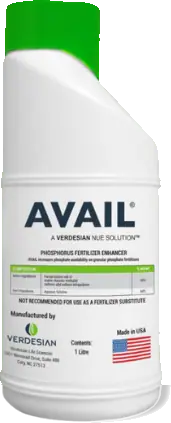
AVAIL® is used with phosphatic fertilizers such as DAP and SSP. It is a resin-based technology with a charge of −1800 meq CEC. It attracts and binds positive ions – calcium, magnesium and aluminium – in the soil, leaving phosphorus free for uptake by crop roots. AVAIL improves phosphorus solubility and promotes season-long phosphorus uptake, making up to 45% more phosphorus accessible to crops. Benefits include better early-season crop performance, a more robust root and shoot system, increased yield and ROI, and less phosphorus build-up in the soil.
Steric P is soil-applied at 800 g per acre. It delays the chemical fixation reactions of phosphorus in alkaline or acidic soils. Its patented steric chemistry wraps around the phosphate ion and shields its negative charges, so the phosphate cannot react with soil chemistry. This keeps phosphorus available for longer. Steric P supports crop vigour, root mass, plant immunity and soil health.
For dosing and application details of AVAIL with your fertilizer, refer to the product handbill or speak to a Verdesian agronomist.
Step 6: Build soil organic matter
Farmyard manure, compost, green manure and crop residue incorporation improve soil structure and biological activity. Soils with better organic matter generally hold phosphorus in more available forms and support stronger root systems.
Step 7: Watch the crop
Early phosphorus deficiency often shows as stunted growth, poor root development, delayed maturity and, in many crops, a dark green or purplish tinge on older leaves. Purple colour can also appear in cold weather, so confirm with a soil or plant test before acting.
Common mistakes to avoid
- Broadcasting DAP on the surface. Phosphorus barely moves, so surface-broadcast P often stays out of reach of roots.
- Applying P late as a top dressing. Phosphorus is needed early; late surface application gives little return.
- Ignoring soil pH. In very alkaline or very acidic soils, fixation is high – more fertilizer alone does not solve it.
- Skipping soil tests. Many fields have phosphorus build-up and may not need the same dose every season.
- Seed-fertilizer contact at high doses. It can damage germinating seed.
- Treating P in isolation. Phosphorus works best when nitrogen, potassium and micronutrients like zinc are also in balance.
Phosphorus management checklist
- Soil tested for pH and available phosphorus in the last two to three years
- Fertilizer quantity based on soil test and local recommendation
- Phosphatic fertilizer drilled or banded near the seed row, not surface-broadcast
- Full phosphorus applied as basal dose at sowing or transplanting
- Fertilizer enhancer planned with DAP/SSP – AVAIL®
- Soil-applied fixation protection considered – Steric P at 800 g per acre
- Organic matter added through FYM, compost or residues
- Crop checked in the first weeks for signs of phosphorus stress
Talk to a Verdesian agronomist
Every soil fixes phosphorus differently. Contact a Verdesian agronomist to plan phosphorus management for your soil and crop, or request trial reports to see AVAIL and Steric P results.
Frequently asked questions
Why does my crop show phosphorus deficiency even after applying DAP?
Much of the phosphorus applied through DAP or SSP can react with calcium in alkaline soils, or with iron and aluminium in acidic soils, and become fixed in forms roots cannot easily take up. Soil pH, placement and timing all affect how much stays available.
How does AVAIL work with phosphatic fertilizers?
AVAIL is a resin-based technology used with phosphatic fertilizers such as DAP and SSP. It attracts and binds positive ions like calcium, magnesium and aluminium in the soil, leaving phosphorus free for uptake by crop roots.
What is the dose of Steric P?
Steric P is soil-applied at 800 g per acre. It delays the chemical fixation reactions of phosphorus in alkaline or acidic soils so phosphorus stays available for longer.
How often should I test my soil for phosphorus?
A soil test every two to three years, or before a major change in cropping, is a sensible practice. Test pH along with available phosphorus, as pH strongly affects phosphorus availability.